Material updated:
Six scenario directions: integrated mine safety; unmanned inspection in hazardous areas; natural-disaster and sudden-fire emergency rescue; inter-island and remote-area low-altitude transport; high-threshold embodied AI applications in Europe; and water-based intelligent equipment.
These are reference research and solution-solicitation materials. Six themes do not mean six validated or delivered projects; specific tasks, sites, budgets and implementation conditions require individual confirmation.
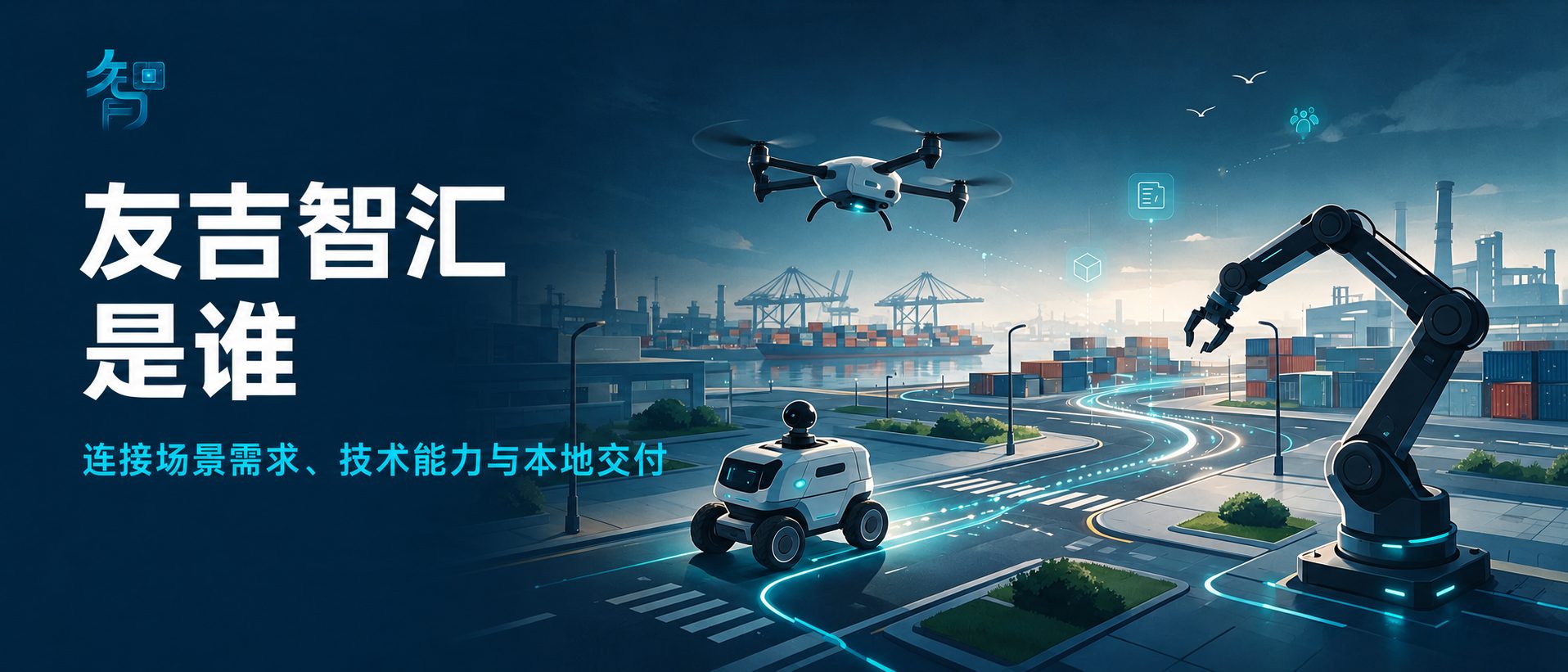
How many rounds of confirmation does it take for a technology to move from an exhibition booth into a factory, an industrial park, or an overseas site?
What the equipment can do is only the first question. Why the site needs it, whether it can handle the operating conditions, how it connects with existing workflows, who will operate and maintain it, and how results will be accepted — together, these determine whether a project can move forward.
This journey — from technical capability to practical application — is exactly what YouJi Nexus focuses on.
YouJi Nexus focuses on embodied AI and low-altitude applications, conducting ongoing industry research, scenario discovery, enterprise research, offline matching and themed exchanges. We connect scenario demand owners, technology providers and local delivery partners, advancing cooperation from task definition to solution adaptation, application validation and deployment.
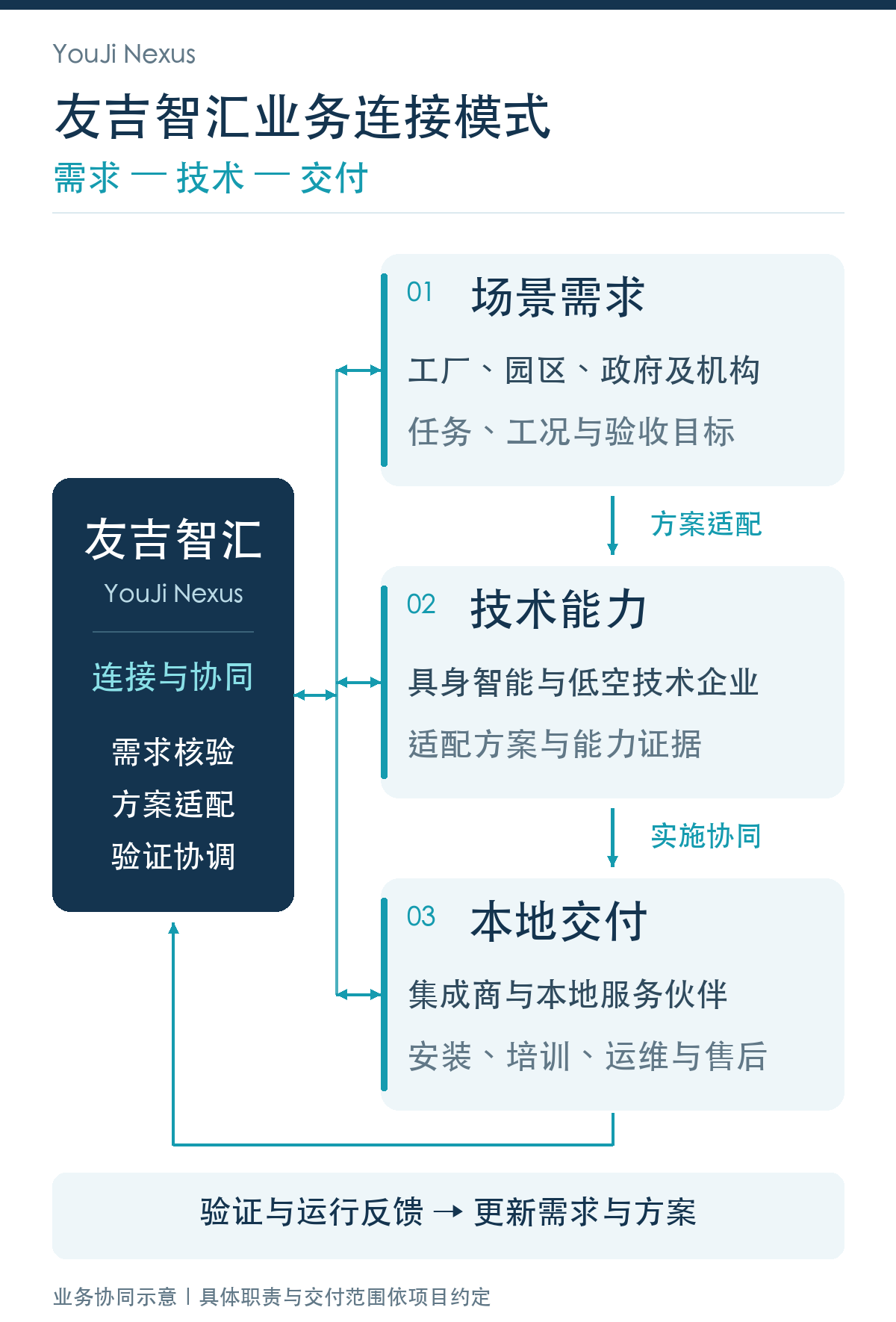
01 Starting from a concrete task
"We want to bring in robots" calls for further answers: at which step of the process, under what conditions, to complete which task?
"We want to launch low-altitude transport" calls for specifics: what will be carried, how often, and are the takeoff/landing and operating conditions in place?
"We want to enter overseas markets" also requires clarity: who faces which problem, who takes part in procurement, and who can provide local service?
In YouJi Nexus's work, a scenario is an operational process with a concrete environment, task, participants and evaluation criteria.
It may be an equipment inspection route, a warehouse material-handling workflow, or a supply transport mission in a remote area.
Only when the task is clear can solutions be compared; only when operating conditions are clear can fit be judged; only when responsibilities and acceptance criteria are clear can investment be discussed.
02 Advancing scenario applications — what does that involve?
YouJi Nexus connects industry information, offline exchanges and project collaboration, working continuously around practical applications in China and overseas:
Discovering and mapping scenarios. Identify tasks from industry developments, public cases, enterprise exchanges and on-site feedback; organize the problems, participants, operating conditions and conditions yet to be confirmed.
Researching and understanding the site. Conduct enterprise research and exchanges around concrete tasks to understand current working methods, technology-fit conditions and local service needs.
Organizing offline matching. Through supply–demand matching events, themed activities and targeted exchanges, bring scenario owners, technology providers, integrators and local service partners together to discuss cooperation around the same task.
Shaping solutions and validation paths. Consolidate information from exchanges into scenario blueprints, compare capability combinations, alternatives, investment conditions and validation methods, and clarify the evidence needed next.
Advancing validation and deployment coordination. Based on project conditions, drive demand verification, solution matching, small-scale validation and subsequent implementation, and coordinate participants on division of work, delivery and operation arrangements.
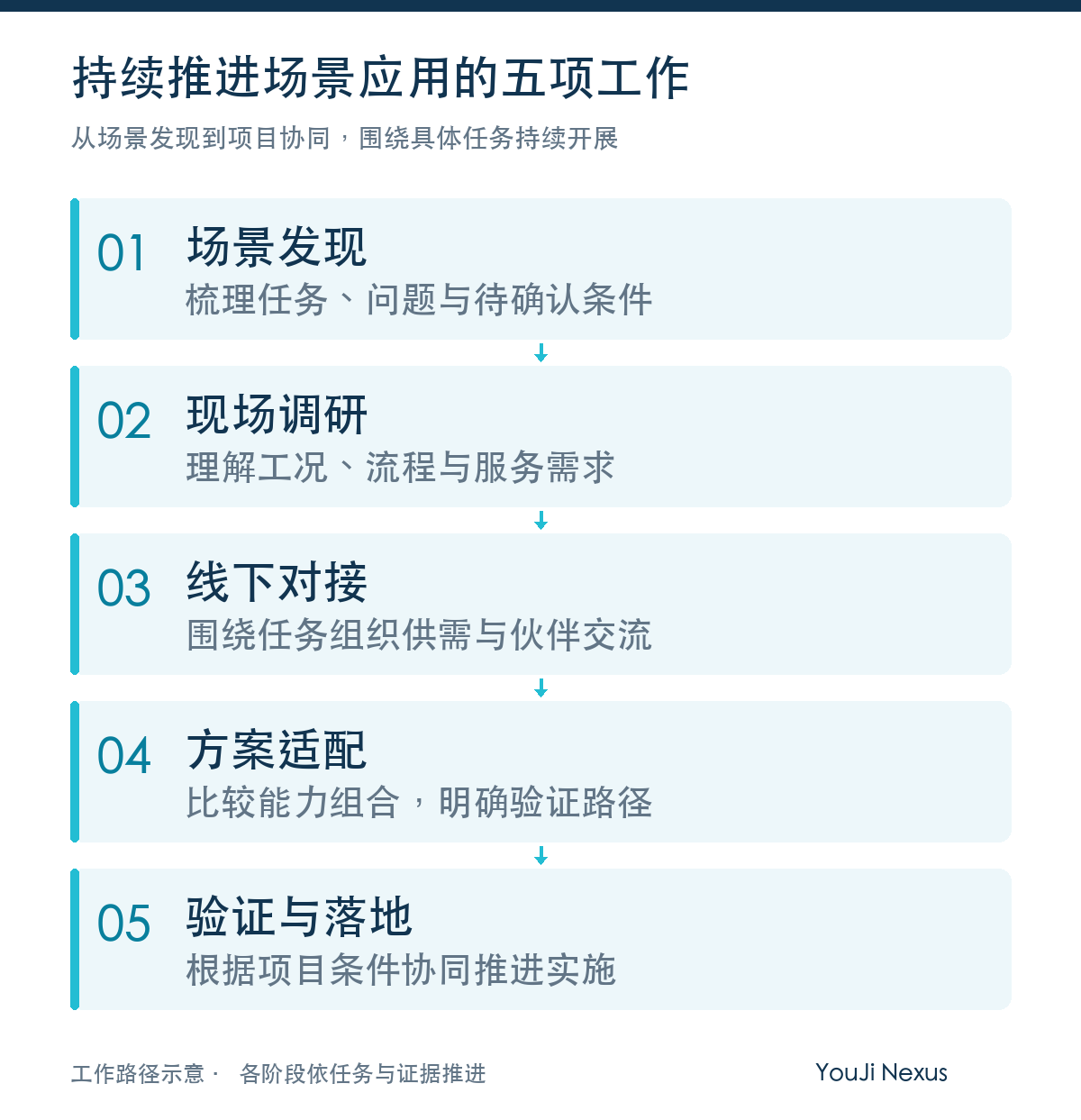
Offline events are the connecting link in this ongoing process. Tasks, questions and capability leads that emerge from exchanges feed into further research, communication and project assessment.
03 What roles do the brand, the platform and the WeChat account play?
YouJi Nexus conducts offline industry communication activities such as research, matching and coordination, focused on scenario discovery and collaborative validation. YouJi Nexus is the external brand: around embodied AI and low-altitude applications, it carries out scenario research, industry exchanges and project collaboration.
The YouJi Nexus platform is the public resource and participation gateway. Through app.youjinexus.com, you can explore scenario opportunities, read blueprints, search enterprise and solution profiles, submit a need or a solution, and view scenario collaboration and event information.
The WeChat official account is the window for ongoing communication. There we share industry observations, method explainers, event records and publishable practice updates, explaining where our judgments come from and the conditions under which they apply.
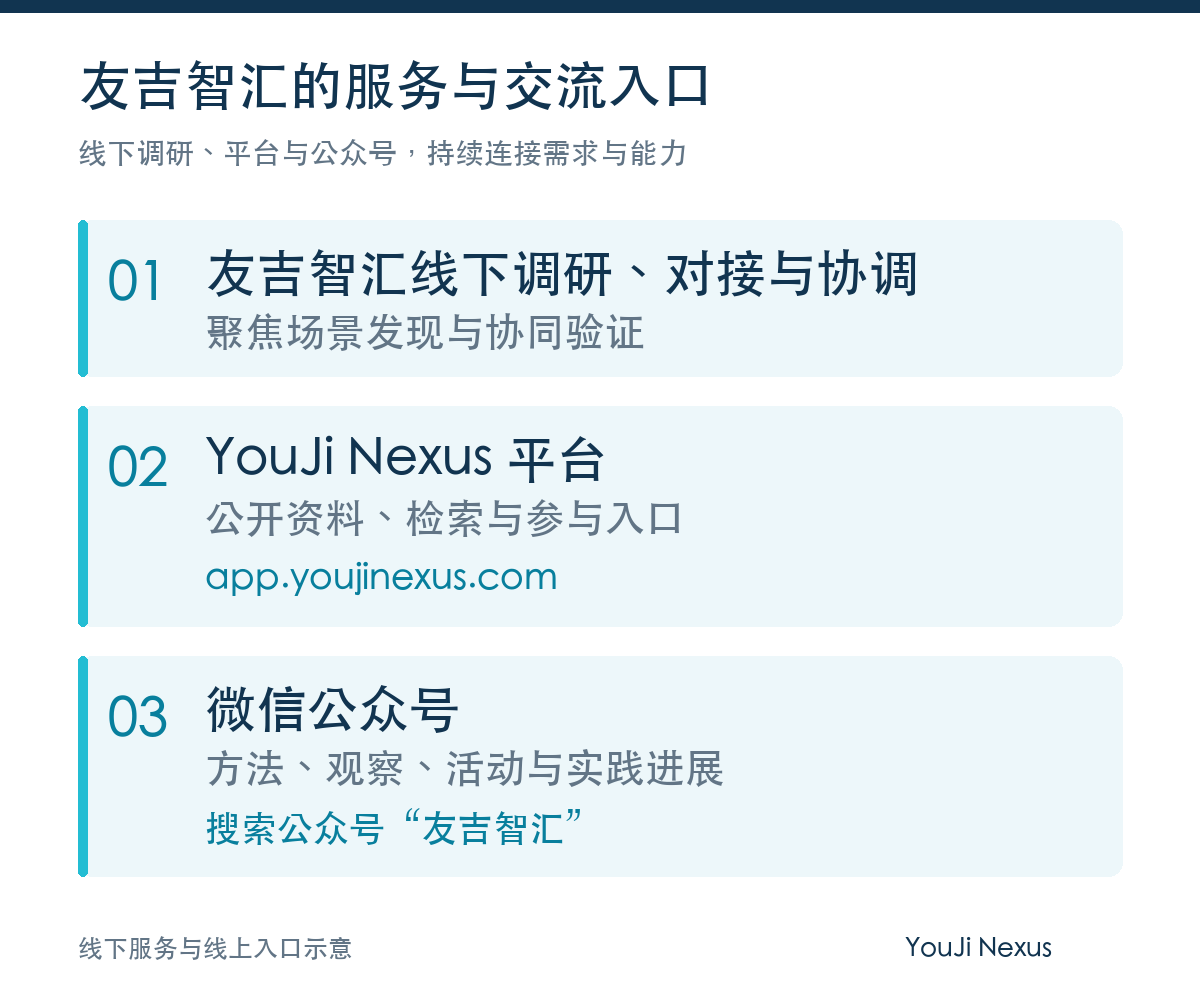
Around specific projects, YouJi Nexus organizes enterprise capabilities, public cases, industry developments and exchange feedback into task descriptions, solution analyses and questions pending verification, providing a basis for subsequent matching and validation. Scope of services, collaboration arrangements and delivery responsibilities are confirmed by the participating parties according to each project.
04 Two recent examples: from on-site observation to scenario matching
In August 2026, we took part in EDRR Indonesia 2026. YouJi Nexus held exchanges on how embodied AI enters firefighting and industrial safety sites, and compiled observations on equipment tasks, similar cases, training and maintenance, spare parts supply and local services into WeChat articles. [1]
On September 18, 2026, we hosted a scenario matching event at Shanghai Pudong Software Park. "Scenario Breakthroughs · Intelligence Goes Global — Matching Event on Overseas Real-Scenario Validation and Industrial Deployment" brought together companies and institutions along the industry chain for themed exchanges on overseas tasks, operating conditions and delivery requirements. [2]
The event explored six overseas scenario blueprints through task breakdowns and on-site one-to-one matching: mining comprehensive safety, hazardous-area unmanned inspection, natural disaster and fire emergency rescue, inter-island and remote-area low-altitude transport, high-threshold embodied AI applications in Europe, and water-based intelligent equipment (including waste collection, water-rescue robots and unmanned vessels). These blueprints are reference materials for demand verification and solution adaptation, not evidence of six validated or delivered projects.
These two events are recent examples of YouJi Nexus's ongoing scenario discovery and industry collaboration. Further work continues around enterprise exchanges, scenario mapping, solution research and follow-up matching.
Blueprint publication, expressions of interest, demand confirmation, project validation and delivery acceptance are different stages. We record results according to actual progress, and keep adding sources and conditions of applicability.
05 Why local delivery matters
Once equipment reaches the site, someone must be responsible for installation and commissioning, operator training, routine maintenance and fault response. Communications, data interfaces, spare parts and work procedures also affect actual usage.
That is why these questions should be asked early when comparing solutions: Who provides site conditions? Who supports the equipment? Who handles exceptions? Who accepts the results?
Through early-stage research and coordination, YouJi Nexus brings these questions into the discussion sooner and ties them to specific participants and next actions. Cross-region cooperation also requires re-confirming implementation and operation arrangements against local conditions.
Where to start a conversation with YouJi Nexus?
If you have a scenario need, describe your current working method, the problems you face, and the outcomes you hope to improve.
If you have a technology or solution, share your core capabilities, applicable operating conditions, existing application evidence and service coverage.
If you are from government, an industrial park or an industry organization, raise topics around specific application needs, enterprise exchanges, scenario co-creation or industrial cooperation.
If you are an integrator or local service partner, describe your capacity to take on installation and commissioning, training, spare parts, and operations and maintenance.
A clearly stated problem, a verifiable capability profile, or a validation with well-defined boundaries — any of these can be a starting point for cooperation. State the need clearly, bring the evidence, and turn the next step into concrete action.
Enter the YouJi Nexus platform: app.youjinexus.com
Further reading & sources
[1] "EDRR Indonesia 2026: The Real Starting Point for Embodied AI Going Global" — on-site recap (EN) + original WeChat article
[2] "From Scenario Blueprints to Post-Event Matching: YouJi Nexus Moves Embodied AI Going Global into Task Validation" — on-site recap (EN) + original WeChat article