An overseas scenario blueprint may connect robots, low-altitude equipment, software systems and local service partners. But from "having a direction" to "worth investing in validation", one more question must be answered: who does this test help make what decision?
A PoC (proof of concept) tests within a limited scope whether the solution can complete the agreed task. Its value is using field evidence to reduce uncertainty in the next decision. One successful demonstration does not mean sustained operation; a reference blueprint does not mean a confirmed procurement need.
The paid PoCs YouJi Nexus advances in China and overseas are organized around real operating conditions, a defined budget and a validation orientation: state the task and conditions clearly first, then work with the scenario owner, technology providers and local partners to determine solution adaptation, validation scope and costs.
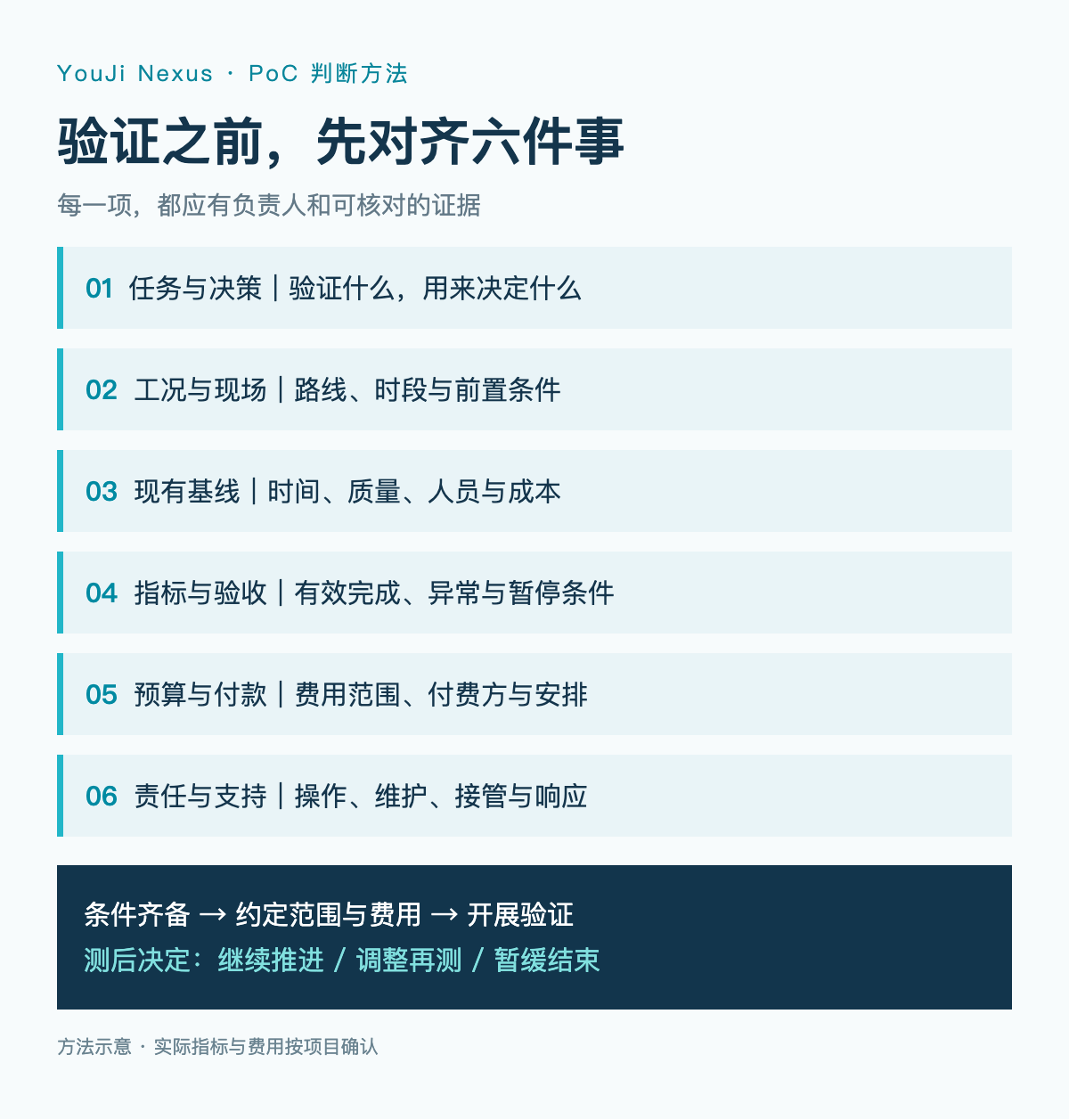
1. Six conditions that decide whether a paid validation is worth starting
| Criterion | Ready for validation | Fill gaps first or hold | Evidence to expect |
|---|---|---|---|
| Task and decision | The specific task, the demand owner and the post-validation decision are clear | Only "we want intelligence", with no one confirming the task | Task description and owner confirmation record |
| Site and operating conditions | Site, routes, working time windows and necessary prerequisites can be confirmed | The site is inaccessible; key environmental or operating conditions unknown | Site materials, survey records, list of conditions to verify |
| Current baseline | Time, quality, staffing and cost of the same task are recorded | Inefficiency judged by impression only, with nothing to compare | Records of the current process, statistics definitions and samples |
| Metrics and acceptance | Valid completion, manual takeover, exceptions and pause conditions are agreed | Vague metrics, or showing only the best run | Test plan, metric definitions, acceptance owner confirmation |
| Budget and payment | Validation budget, paying party, cost scope and payment arrangements are clear | Interest without an investment plan, and no one bears the costs | Budget confirmation, quotation and service agreement |
| Responsibilities and support | Site, equipment, operation, maintenance and incident response have assigned owners | No takeover after the test; after-sales and local support missing | Division-of-work table, support scope and response arrangements |
If key items are unconfirmed, close the gaps first. Even when the equipment has existing cases, check how the case conditions differ from this task. Matters requiring operation permits, certification or special assessments should be verified by the relevant participants against local requirements, and cannot be skipped on product descriptions alone.
2. Method example: an overseas warehouse inspection route
The following is a hypothetical test design; it does not correspond to an implemented project or actual validation results.
Suppose an overseas warehouse wants to verify whether a mobile robot can assist equipment inspection. Step one: limit the scope to ordinary-equipment corridors — visible-light image capture and recording at 10 designated checkpoints within agreed time windows; hazardous areas, equipment control and automated response are not included.
The site lead first provides the route and manual inspection records and confirms corridors, lighting, communications, pedestrian traffic and the anomaly-review process. The solution provider compares manual tools, fixed capture points and mobile platforms, stating why the robot is chosen and which capabilities still need verification.
Suppose the parties agree on 6 capture rounds, which should yield 60 point records. The acceptance sheet could read:
- Valid records: at least 57 of 60 records meet the image-clarity, checkpoint-correspondence and complete-timestamp requirements; misses and manual re-captures are listed separately.
- Route execution: full completion, manual takeover and non-completion are counted separately, with reasons recorded.
- Actual workload: operating, reviewing, re-capture and maintenance time are recorded side by side, compared with the current method on the same task scope.
- Exception handling: problems, responders and recovery are recorded; when triggers such as personnel entering restricted areas occur, the test pauses under the pre-agreed rules.
The "57" is an example threshold only; actual criteria are agreed against the baseline and the intended use. Equipment, software adaptation, shipping, on-site support and local maintenance costs should be budgeted before starting, with the payer stated.
The decision this PoC should support is: whether to expand validation, adjust the capability mix, or stop the current solution. Six rounds of data describe this test's performance; they do not yet prove long-term reliability, let alone directly estimate labor-cost savings.
3. After the test, a clear conclusion is mandatory
When validation ends, the report should arrive at one of three conclusions:
Proceed: metrics meet the agreement; further clarify the expanded scope, delivery conditions and budget.
Adjust and retest: identify the specific causes, and state the adjustments, new costs, responsible owner and review time.
Pause or end: insufficient task value, poor site fit, or necessary resources cannot be secured; keep the evidence and the re-evaluation conditions.
The report should keep planned and actual records, manual interventions, exceptions, costs and applicable boundaries. Only after implementation scope, delivery arrangements and acceptance conditions are confirmed can the project enter the next stage. Reference blueprints, validation records and delivery cases each state the facts of their own stage.
Bring one concrete task to YouJi Nexus
Please first state: your region and site, the task to validate, the current method, the results you hope to improve, the responsible owner, timing and budget range. Technology companies should also state their closest cases, validated capabilities, capability gaps and local support conditions.
Platform path: open the YouJi Nexus platform → Scenario Deployment Services → PoC & Rental → Submit a scenario need to start a PoC evaluation.
Platform: app.youjinexus.com
Business email: contact@youjinexus.com
You can also reach us via WeChat or WhatsApp through the QR codes on the Work with Us page. For the first contact, stating your task is enough; the scope for exchanging detailed site materials and non-public documents is confirmed in later communication.