
"Can drones carry goods between two places?" Discussions often start with payload and range. For demand owners, a more useful starting point is: which goods need to arrive how fast, what gaps the current method has, and who organizes and who pays for the service.
Inter-island and remote-area low-altitude transport is one of the scenario directions YouJi Nexus continuously researches and engages. Around this theme we use the following task-verification method: state the transport need first, then check site and operating conditions, and evaluate the solution by complete delivery.
01 What to carry, how much, and why does faster matter?
The first task card should state at least: shipping and receiving points, goods category, packaged weight and dimensions, demand frequency, the latest acceptable delivery time, and the specific impact of delays.
Industrial spare parts, ambient medical consumables, temperature-controlled medicines, test samples and relief supplies each have different packaging, handover and handling requirements, and should be discussed separately.
Distinguish the demand frequency as well: fixed replenishment, occasional urgent shipments and emergency standby. Fixed schedules can dilute part of the costs; occasional urgent shipments may suit per-trip services better; emergency standby also requires explaining how training and maintenance are done in normal times, and who bears the standby cost.
YouJi Nexus's current research focus is small-volume, time-sensitive goods with clear shipping and receiving parties, starting by finding specific tasks that can be verified.
02 Record how boats and trucks deliver today, then judge the incremental value of air transport
When comparing scheduled boats, dedicated urgent vessels, land transfer or existing air services, keep the goods, origin–destination and time requirements identical.
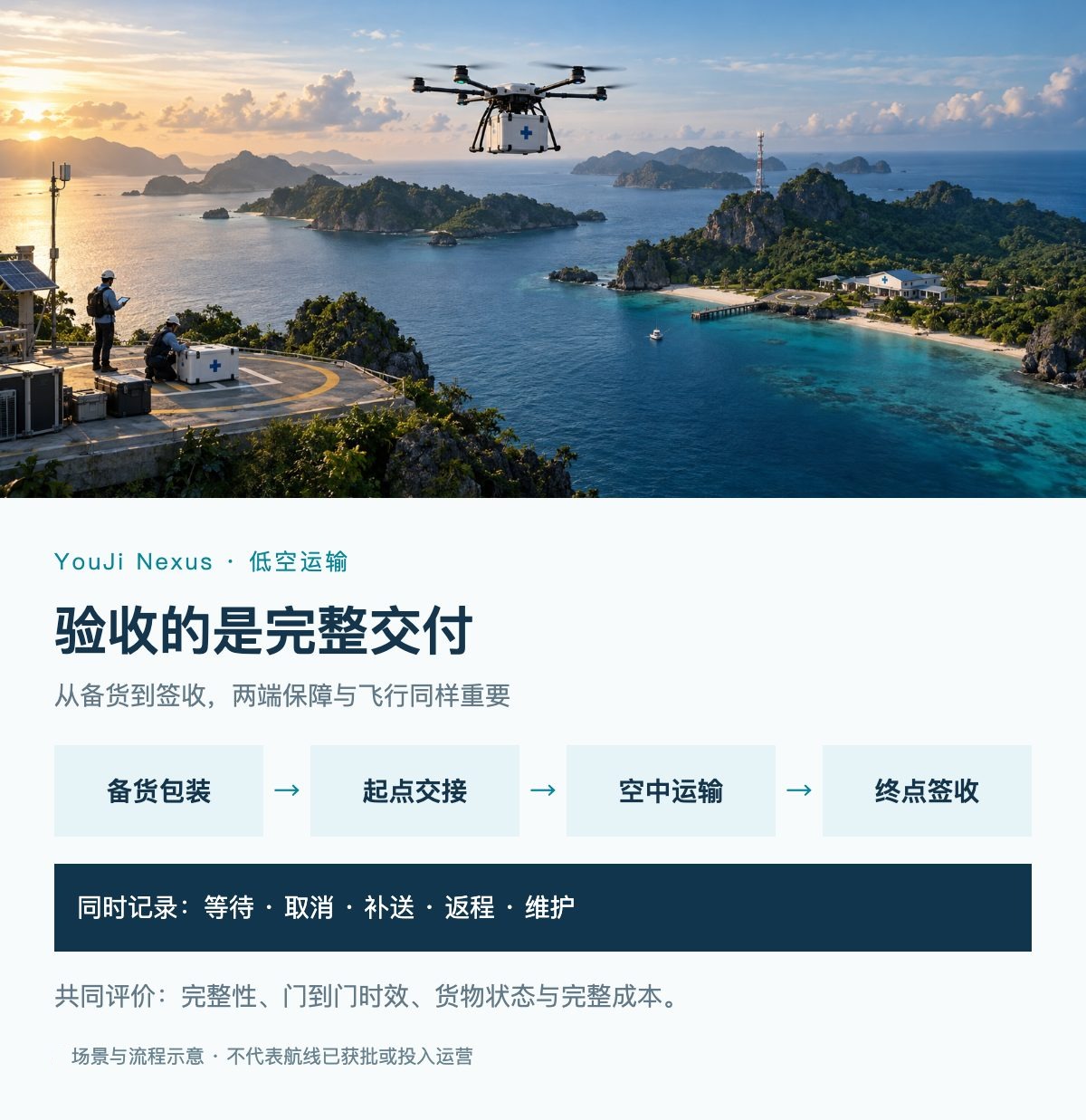
Record the whole process from raising the demand, stocking, waiting and transport to signed receipt, and verify the reasons for delays and cancellations. Airborne flight is only part of the service chain; waiting and connections before and after takeoff/landing also affect the result.
Cost comparison should also look at actually replaceable spending. If the goods previously travelled as add-on cargo on scheduled sailings, compare the cancellable marginal cost; only if a dedicated vessel is genuinely needed should the corresponding dedicated-trip spending be compared.
How much value "faster" creates should be explained by the real task. A generic "logistics is inconvenient" makes it hard to judge whether customers will keep paying for the service.
03 One route needs ground and air conditions to hold together
The following is a preliminary verification checklist, not an approval to operate the route.
| Item to verify | Questions to answer |
|---|---|
| Shipping and receiving | Who arranges the goods, and who inspects and signs for receipt? Can both parties be in place on task time? |
| Takeoff/landing and handover | Are the sites available, and who has the authority to approve? How do personnel and goods hand over safely? |
| Route and communications | How are the route environment, links, navigation and lost-link handling to be verified? |
| Payload and support | Do packaged payload, return-trip energy, batteries and maintenance arrangements cover the mission? |
| Weather and cancellation | Under which conditions are operations suspended? Who decides? How are re-deliveries arranged after cancellation? |
| Local operating conditions | Who checks the applicable aviation, cargo, personnel and insurance requirements? |
Operating requirements in each location should be confirmed by the competent authorities and local operators with the corresponding capabilities. For controlled-site demonstrations, short-range flights and target-route operations, record the conditions available in each case.
04 What public cases teach: service organization matters as much as the aircraft
When Toyota Tsusho announced its medical delivery business for the Goto Islands, Japan, in April 2022, it disclosed the base, the local operating company and a long-term demonstration contract with a medical wholesaler — a reminder to look at the organizational links between shipping, operations and receiving. Toyota Tsusho announcement
In UNICEF's 2018 vaccine transport project in Vanuatu, the records cover insulated packaging, ice packs and temperature loggers. For temperature-sensitive goods, arrival is not enough — the goods must still meet the conditions for use. UNICEF project record
The above are historical project materials from other organizations, provided as method references. YouJi Nexus's candidate tasks still require re-verification of local demand, operating conditions, operations and cost conditions.
05 PoC acceptance: what counts as one qualified delivery?
The following is a method example, not an actual project result: in a validation arrangement with the necessary conditions, 10 simulated cargo missions are agreed. The test plan should state shipping, handover, return and stop conditions.
Suppose 8 missions are completed and 2 are cancelled for weather: the report should keep all 10 planned missions and the cancellation reasons, then evaluate the delivered missions separately. Counting only post-takeoff success omits whether the service could be provided on time.
Record at least five results:
- Delivery integrity: goods, receiver, time and records can be matched.
- Door-to-door time: from request or picking start to signed receipt; the start point is agreed in advance.
- Goods condition: packaging, seals, damage, and temperature-control or other requirements applicable to the goods.
- Exceptions and recovery: causes, handling and costs of cancellations, lost links, faults and re-deliveries.
- Full cost: flight, ground staff, packaging, insurance, maintenance, return legs and contingency.
A small number of tests can help find problems; afterwards, stability still needs to be recorded continuously, covering different operating conditions according to the task.
06 From one validation to a service someone will buy
Commercial discussions must clarify whether the customer buys equipment, per-trip transport, or transport-capacity assurance for a period. Different models correspond to different assets, staffing and cost responsibilities.
Suppliers should state which equipment and service costs occur in the PoC phase and which belong to later implementation. Demand owners should clarify who bears the validation cost, who confirms the results, and under which met conditions procurement or service contracts are discussed.
Confirm the goods, frequency, handover, paying party and operations partner before discussing equipment investment. Bulk cargo transport, personnel transport and feeder aviation can be studied separately, with their conditions and economics accounted for separately.
Turn a transport idea into a task you can communicate
YouJi Nexus works on task definition, solution adaptation, local partner matching and validation coordination. Transport operations and professional responsibilities in a specific project are borne by the parties agreed for that project.
When contacting us, please provide: country/region, shipping and receiving points, goods and packaging information, frequency and time requirements, current method, the responsible person, planned timing and budget range. Mark unclear items as "to be confirmed".
To submit: open the YouJi Nexus platform and submit a scenario; for reference materials, see Scenario Blueprints.
Business email: contact@youjinexus.com